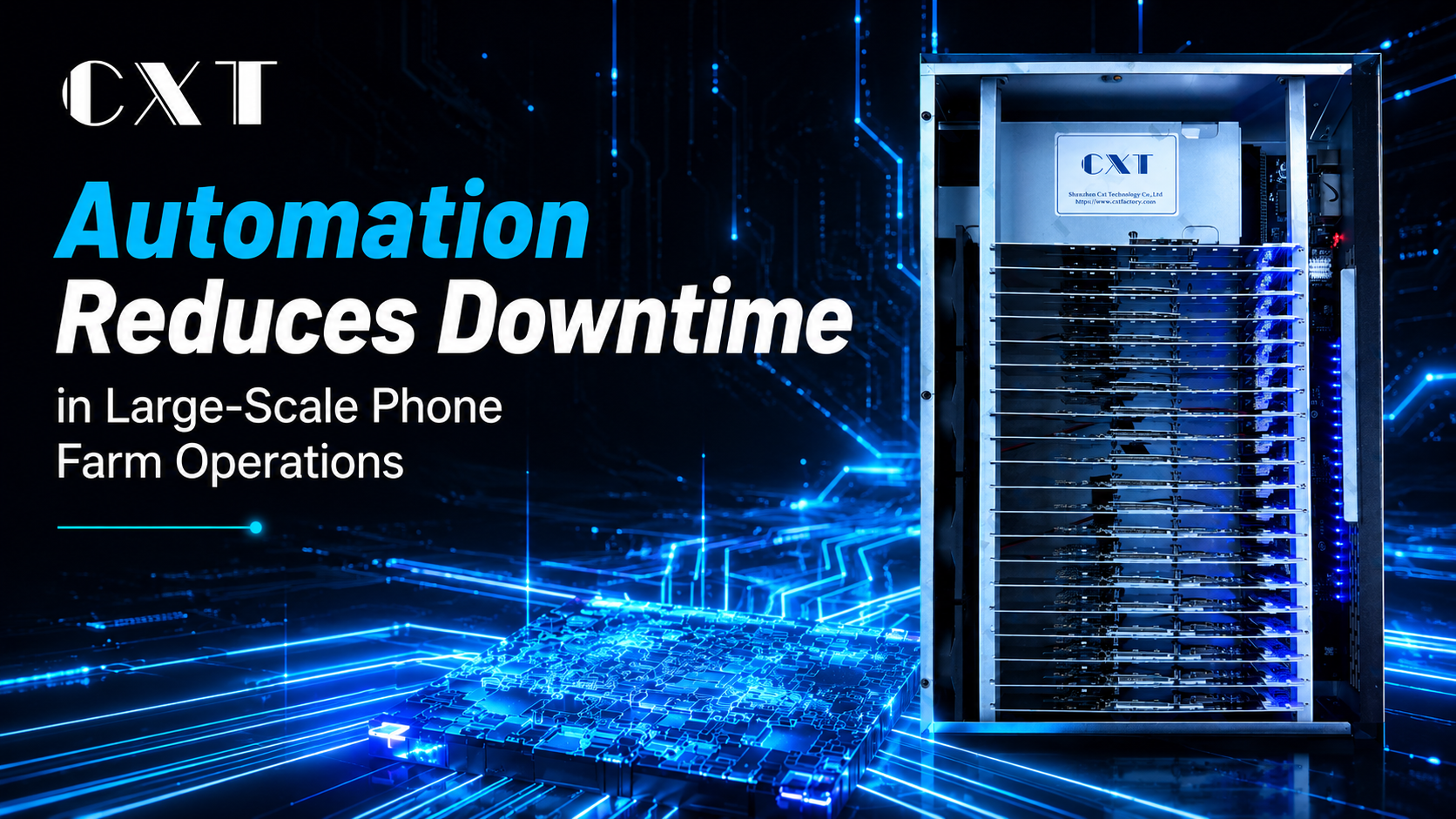
Most people outside the industry don't realize how fragile a large-scale phone farm can be. Not because the hardware is bad - but because at a certain size, even a 2% failure rate means dozens of devices sitting dead at any given moment. Multiply that by hours, and you're looking at a serious dent in productivity.
The real question isn't whether things will go wrong. They will. The question is how fast your setup recovers when they do - and that answer almost always comes down to how well your operation is automated.
What Actually Causes Downtime in Large Device Operations
Before fixing a problem, it helps to understand where it comes from. In most large-scale device setups, downtime isn't caused by one big failure - it's death by a thousand small ones.
App updates push overnight and break scripts. Devices overheat and throttle. Network connections drop silently without triggering any alert. A single misconfigured profile can quietly stall dozens of tasks before anyone notices.
The bigger the operation, the harder it becomes to catch these things manually, which is why human-supervised setups tend to bleed efficiency without anyone fully realizing it.
How Automation Plugs the Gaps
Modern Phone Farm automation is built specifically around catching these failure points before they compound.
Here's where it makes the biggest difference:
- Automated health checks run continuously across every device, flagging anything that drifts outside normal parameters - battery levels, app responsiveness, network latency - without waiting for a human to notice.
- Self-healing scripts detect task failures and restart processes automatically, often resolving issues in seconds rather than minutes or hours.
- Scheduled maintenance windows handle updates, cache clears, and reboots during off-peak hours, so productivity stays intact during active operation cycles.
- Centralized dashboards give operators a real-time view of every device's status, so when something does need human attention, it's immediately obvious where to look.
The Scale Factor: Why It Matters More as You Grow
Here's something that doesn't get said enough - automation's value multiplies as your operation grows. A ten-device setup can be managed manually without too much pain. But at 500 devices? At 2,000? Manual oversight doesn't just become harder, it becomes practically impossible to do well.
This is a challenge that operations modeled after a Chinese phone farm infrastructure approach head-on. Large-scale Chinese device farms have long relied on tight automation layers precisely because the human-to-device ratio simply can't scale any other way.
The lesson translates well regardless of geography: once you cross a certain threshold, automation stops being a nice-to-have and becomes foundational.
Reducing Recovery Time When Things Do Go Wrong
No system is perfectly failure-proof, and automation doesn't pretend to be. What it does is dramatically shrink the recovery window.
A well-automated phone farm can detect an issue, attempt a fix, log the result, and escalate to human review - all within a minute or two of the problem starting.
Compare that to a setup where someone has to notice the problem, diagnose it, and fix it manually. That gap can easily stretch to hours.
Faster recovery means more uptime, and more uptime means better output consistency - which ultimately matters more than raw device count in many use cases.
Final Thought
Downtime rarely announces itself loudly. It creeps in through small inefficiencies, quiet failures, and slow manual responses.
Building solid phone farm automation into your operation isn't about replacing people - it's about giving them fewer fires to fight.
At Shenzhen CXT Technology Co., Ltd., we build device infrastructure with reliability at its core. If you're looking to tighten up your operation, reach out to us - we're happy to talk through what's possible.