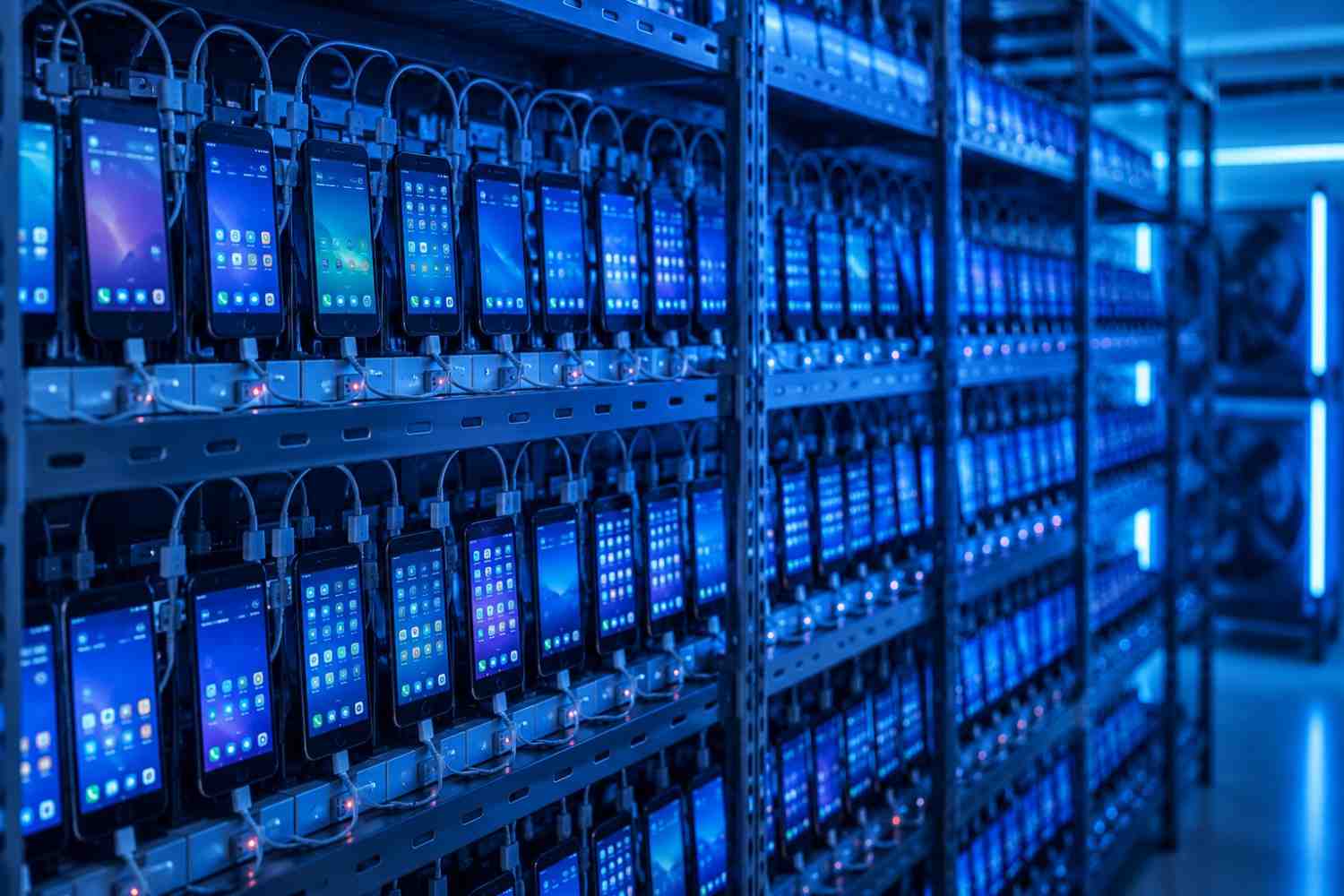
Mobile application testing, quality assurance, automation development, device research, content operations and many other authorized operations may involve use of the phone farms. However, they are also known to be involved in various scams, including but not limited to fake clicks, installs, and engagements.
This tutorial describes in detail how phone farms work, how to set up a phone farm, what you need to have, their costs and how to manage them. Phone farm is a system involving multiple physical phones that share infrastructure services.
1. What Are Phone Farms?
A cluster of phones operating as a managed device setup is known as a "phone farm."
A typical setup includes the following:
- Several smartphones
- Charging equipment
- Network connectivity
- Device management software
- Phone holders/racks
- Airflow/cooling system
- Monitoring tools
Whereas big companies may have many or even hundreds of devices, small phone farms may have only a few.
In contrast to just having a number of phones, a phone farm is meant for systematic and repeatable device operations.
Application testing, QA, device compatibility testing, and authorized content delivery pipeline are some of the legitimate uses of phone farms. In addition, phone farms can also be used for mobile advertising fraud, which has been pointed out as a threat by AppsFlyer due to fake clicks or installs by the devices.
2. How Do Phone Farms Operate?
Five fundamental elements make up a phone farm:
Phones → Power → Network → Workflow → Management Software
While being controlled by a central computer or software platform, each smartphone functions as a separate physical device.
Tools like ADB (Android Debug Bridge) for device commands and scrcpy for screen control and mirroring are frequently used in Android farms. ADB and scrcpy are also used in the real-device process of ShadowPhone's 2026 instructions.
Whether the farm is being utilised for testing, automation, research, or another approved purpose determines the precise configuration.
3. Setting Up a Phone Farm
Setting up a phone farm is an objective that should precede the number of phones.
Easy setup procedure:
- Identify the workload.
- Select suitable smartphones.
- Install power infrastructure.
- Install network infrastructure.
- Add cooling and racks.
- Install management software.
- Test small number of devices.
- Expand when reliability is demonstrated.
Generally speaking, it is usually easier to begin with three to five devices than to start out with many phones all at once.
You can scale gradually to 10, 25 or more devices.
4. Hardware for Phone Farms
The following are some of the main hardware considerations:
Smartphones
Choose the devices based on various considerations such as processor speed, RAM, USB, software compatibility, battery, and replacement parts.
According to ShadowPhone, one should assess the hardware capabilities of GrapheneOS at present while making a purchase and recommend Google Pixel smartphones for later versions of Android.
Charging Devices
Although large farms will need centralised control and a multi-port charging hub, smaller farms will be able to do with individual chargers.
Racks
Use open racks or shelves to organise your gadgets and ensure air circulation around them.
Cooling
Phones generate much heat when being used continuously. As your fleet grows larger, you might need to use fans, room cooling, and spacing.
Network Devices
You could need mobile data, Ethernet, or WiFi connectivity, or any combination thereof based on your requirements.
5. Software for Phone Farms
The software is required to make the phone farms efficient enough in handling multiple handsets.
Common components include:
- ADB for controlling Android phones
- scrcpy for handling screen control
- Appium for mobile application testing
- Automation with custom scripting using languages like Python etc.
- Device handling platforms for centralized handling of devices
Specialized software can help automate and streamline processes for larger companies.
Currently, ShadowPhone offers software solutions that revolve around automation of physical phones.
6. How Many Phones Does a Phone Farm Need?
There is no set number.
| Farm Size | Typical Purpose |
|---|---|
| 1–5 phones | Testing and learning |
| 5–10 phones | Small business |
| 10–25 phones | phones Moderate configuration |
| 25–50 phones | Greater operation with more than 50 phones and dedicated infrastructure |
Starting off with five phones is helpful for beginners. The farm size can then be increased when all other aspects such as networking, cooling, power, and software management are stable.
7.. Phone Farms and Traditional Device Farms
Even though they are connected, a phone farm is not a traditional device farm.
Traditional Device Farm and
Phone Farm
Traditional Device Farm
| Phone Farm | Traditional Device Farm |
|---|---|
| Generally, the operator owns the device | Generally, the operator does not own but is a provider |
| Physical access is available | Physical access is generally not available |
| Costly upfront investment | Often subscription model. |
| Device maintenance is perfor Highly diverse devicesmed | The operator and the provider. |
| Highly diverse devices | High hardware management. |
A traditional device farm is usually better for software developers who simply need to test an app on multiple devices.
When you have to maintain physical control over devices, then you need a private phone farm.
8. Costs Associated With Phone Farms
The number and type of units as well as the facilities required will dictate how expensive the phone farm is.
Some of the costs that may include:
- Smartphones
- Charging equipment
- Racks
- Network hardware
- Cooling power
- Software
- Mobile data maintenance
Costs of Software
Public pricing for the ShadowPhone programs are as follows:
- Starter: $97 monthly
- Growth: $247 monthly
- Agency: $497 monthly
Various connection types for phones, profiles for devices, and other platform features are provided by the above-mentioned programs.
Hardware costs vary widely from one vendor and one type of device to another. For example, Google Pixel 7a with 20 devices currently costs $2,100 on the PhoneFarmBox website.
These prices cannot be regarded as industry standards but just examples of vendor pricing.
The more realistic estimate of costs is:
Total Cost = Hardware + Power + Network + Cooling + Software + Maintenance
9. Management of Phone Farms
The task of managing more than one phone by oneself can quickly become difficult.
An efficient management system needs to keep track of:
- Phone model and Device ID
- Operating System version
- Exact position
- Assigned workflow
- Condition of the battery
- Network status
- Temperature
- Software status
Assign an ID to each of your phones; something like FARM-001, FARM-002, or FARM-003.
Maintain some additional spare parts and cables in case of large phone farms so that in case of any hardware problem, the whole process doesn’t get affected.
Regularly check the condition, temperature, storage, connectivity, and software issues of your device.
10. Best Phones for Phone Farms
No single best phone exists that is suitable for every purpose.
For Android automation
The following characteristics should be considered:
- Good USB connectivity
- Long software support lifecycle
- Sufficient RAM
- Consistent performance
- Developer-friendly capabilities
Devices supported by Google Pixel can be ideal choices when deploying Android farms. The ShadowPhone 2026 guide suggests using newly supported Pixel hardware.
For app testing purposes
In reality, several brands can be better:
- The Google Pixel
- Samsung Galaxy OnePlus
- Xiaomi Motorola
There could be issues regarding compatibility between hardware and software in terms of different devices.
11. Acceptable Uses of Phone Farms
There are several valid purposes of using phone farms.
Testing Mobile Applications
Test installation, sign-in, user interface, notifications, and app performance on actual mobile devices.
Quality Assurance and Regression Testing
Test repeatedly using multiple cellphones before deploying the app.
Automation Development
Develop and test mobile automation processes that are allowed.
Content Operations
Operate a large number of authorized company accounts and their content processes using actual devices.
Device Research
Analyze the performance of the mobile device, battery usage, connectivity, and operating system differences.
Remote Device Management
Control multiple devices through a single central place.
But phone farms should never be used for fake reviews, fake engagement, false advertising, unauthorized installs or circumvention of platform rules.
12. Phone Farm FAQs
How many phones do you need to get started with?
Some phones are needed to get started but only 3-5 devices will be enough to understand and test your infrastructure.
Do all phones need a SIM card?
No. There are cases where some systems use Wi-Fi connection, while others depend on mobile data connections depending on the workflow.
Is it mandatory that each phone has a unique IP address?
No. The network demands change depending on the particular application and architecture.
Can old phones be used?
Yes, but only when they still work efficiently and support the particular software required. Extremely old phones might have a weak battery or lack support.
Can phone farms operate 24 hours round the clock?
They can but with proper cooling, power supply and maintenance.
Is it legal to engage in telephone farming?
It is not necessarily illegal to have many phones. However, false advertising, fake engagement, and misleading behavior on social media platforms are all against their policies and might be an issue.
Is telephone farming profitable?
There are no guaranteed profits. It depends on the purpose of using the phones, costs of devices, software, power costs, maintenance, and generating profit from it.
Final Thoughts
A successful phone farm is more than just a collection of smartphones. It is a managed infrastructure that includes devices, power, networking, cooling, software, and monitoring.
Begin small, test the procedure, and compute the total operating cost before scaling.
For most users, the best method is to design a dependable, measurable, and scalable solution that solves a specific business or technical need, rather than purchasing as many phones as possible.