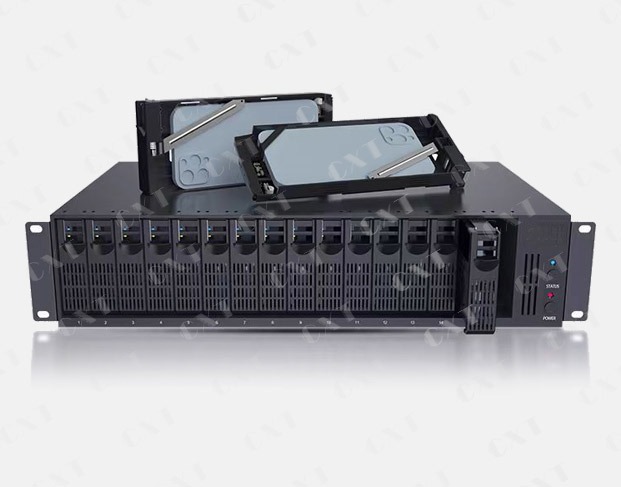
The terms Phone Farm, box phone farm, and bot farm are often used interchangeably, but all of them denote different things. Understanding the differences between them is important, since more and more organizations have turned towards using mobile phones in order to test, automate, conduct research and run mobile operations.
A phone farm refers mainly to mobile-device physical infrastructure, while a box phone farm is a structured hardware facility that handles numerous smartphones. A bot farm, however, revolves around massive automated operations, and these operations can use physical phones, emulators, and virtual infrastructure.
This paper explains the way these facilities function, their applications, requirements for infrastructure, pros and cons, and the things that should be taken into account before scaling.
Inside a Modern Phone Farm
A Phone Farm is a bunch of cell phones that collaborate with each other to achieve different mobile functions.
The organizations can manage many devices at once as opposed to relying on one device for each task. Based on their purposes, a phone farm can consist of either Android phones or iPhones or other kinds of mobiles.
A common arrangement could include:
- Smartphones
- Charging and Power Infrastructure
- Network connectivity
- Device management software
- Remote Control Tools
- Monitoring systems
- Automation software
- Device inventory and maintenance procedures
Phone farms are particularly useful when hardware behavior plays a significant role. For instance, developers may be required to analyze how an application runs on different screen sizes and operating systems, among other factors.
Applications of Phone Farms
There are various practical uses of phone farms.
Mobile Application Testing
The development team can run programs on multiple hardware devices rather than relying on just emulators. This will enable them to spot any errors that might arise.
Quality Assurance
The QA team can reproduce any application errors on multiple versions of operating systems and different hardware setups.
Ad and Content Validation
Organizations might also leverage physical devices to determine how mobile advertisements, websites, and applications perform under various conditions.
Research and Tracking.
A collection of physical devices can assist in carrying out tasks such as mobile research, tracking, localization, and others which require repeated procedures.
Mobile Automation
Repetitive mobile tasks, where possible according to the organization’s policies, can also be automated.
Definition of a Box Phone Farm
Box Phone Farms is a phone farm whereby many phones are grouped systematically into boxes, racks, or controllers.
Unlike traditional phone farms where the phones are laid out systematically, box phone farm ensures a systematic organization of:
- Device mounting
- Charging
- Cable management
- Physical organisation
- Device control
- Space efficiency
Phone farms in boxes are often attractive to those users who need improved hardware setup and higher density of devices.
Nevertheless, buying such a box does not solve any problems associated with operating multiple smartphones.
Box Phone Farm Compared To Phone Farm
The major distinction lies in architecture.
Phone Farm is a broader terminology used for a collection of phones used in conjunction.
Box Phone Farm is just one example of phone farms.
Phone Farm comprises, for instance, ten smart phones that are connected through a rack. Box Phone Farm comprises, however, ten smart phones organized into particular controllers' boxes.
It depends on the amount of units, space, control and maintenance needs, budget.
What Is a Bot Farm?
It’s quite obvious that there’s a difference between a bot farm and a phone farm.
In a nutshell, a bot farm consists of automated processes or systems for performing massive actions. They may utilize:
- Physical smartphones
- Emulators
- Virtual machines
- Cloud infrastructure
- Automation scripts
- Software-based agents
- Software-based agents
Therefore, a bot farm is defined more by automation and activity than by the physical hardware itself.
This distinction is important because a phone farm can be used for legitimate testing and research, whereas the term bot farm is frequently associated with artificial engagement, deceptive activity, fraud, or attempts to manipulate online platforms.
The technology itself is not automatically harmful; the purpose and method of use determine whether an operation is legitimate.
Phone Farm vs Bot Farm
The simplest way to understand the difference is:
| Phone Farm | Bot Farm |
|---|---|
| Focuses on device infrastructure | Focuses on automated activity |
| Usually uses physical smartphones | Can use physical or virtual systems |
| Useful for testing and QA | Often associated with large-scale automation |
| Hardware is central | Automation is central |
| Can have legitimate business applications | Can be legitimate or abusive depending on use |
The first type involves setting up a gadget farm where a company performs testing on 50 smartphones of its own app. In the case of bot farm, it is a tool created for creating large amounts of activity automatically.
What Are The Requirements Of A Phone Farm?
A phone farm that can scale must have much more than just smartphones.
1. Devices
Choose your devices depending on the applications and the OS you intend to support. Diversity in devices might be an advantage when it comes to compatibility tests.
2. Power
The devices require constant power, which becomes more complex as the devices increase.
3. Network
The network must be robust and secured. The network requirements include performance, security, and monitoring of the applications being tested.
4. Cooling
The presence of numerous active devices within the limited area creates heat. Appropriate cooling helps prevent performance problems and device failure.
5. Device Management
In accordance with the growing number of phones, managing them manually is a laborious process. The device management helps to monitor, access remotely, keep an inventory of them, and to manage.
6. Automation
Automation helps in automating repetitive processes of testing and approvals. It would be better if the system has error detection and recovery rather than assuming success of every task.
How Much Does a Phone Farm Cost?
It will be dictated by the scale and architecture of the system.
The total cost should not simply account for the cost of purchasing smartphones.
Other important costs include:
- H/W
- P/E
- Networks
- Software
- Cooling
- Space
- Maintenance
- Replace H/W
- Labor
- Monitoring
- Down time
Therefore, a cheap and do-it-yourself phone farm might not be the most cost-efficient alternative in the long term.
Here is an interesting equation:
Ownership Cost = Hardware + Infrastructure + Software + Labor + Maintenance + Downtime Replacement
In this way, you will get a better idea of your investment.
Scaling Challenges of a Phone Farm
Increasing the scale of operations in a phone farm from 10 to 100 phones poses various problems to consider.
The typical problems may consist of overheating, connection problems, broken connections, phone crashing, software upgrades, storage limits, and manual recovery.
A scalable system needs to enable the answering of questions such as the following to be easy:
- What devices are connected?
- Which have failed?
- Which need to undergo maintenance?
- Which operating system version is installed on the device?
- When can the failed device be substituted by a new one?
- How much manual effort is involved?
Not only is scalability concerned with adding more devices but with increasing capacity without increasing complexity.
Phone Farm, Box Farm, or Cloud Device Farm?
The best option depends on your needs.
A DIY phone farm provides complete physical control but necessitates additional maintenance.
A box phone farm has a more structured physical arrangement, which can increase organisation and device density.
A cloud or managed device farm can alleviate the costs of procuring, maintaining, and replacing physical gear.
Before settling for any of them, one must think about:
- How many devices does one need?
- Is there a need for the hardware?
- On which operating system(s) should the system run?
- How often will the devices be in use?
- Who is going to maintain the infrastructure?
- What are the recurring expenses?
- Can the system expand with minimal physical labor?
Conclusion
Phone Farm should be properly explained as the mobile device infrastructure for managing the large amount of physical smart phones. The box phone farm can be viewed as a structured hardware environment which efficiently manages a large quantity of mobile devices.
Bot farm is special due to its emphasis on automation rather than device infrastructure.
As for the companies, developers and testers, it is essential to start from needs first, to check the effectiveness of the process on a certain number of devices, to determine TCO and only then select appropriate infrastructure.
Not always the most effective phone farm should be the one with the largest number of devices.
Frequently Asked Questions
Is a box phone farm the same as a phone farm?
No. A box phone farm is one type of physical phone farm architecture.
Can phone farms be used to test applications?
Yes. Physical device fleets are useful for testing apps across several hardware and operating system combinations.
Are real phones better than emulators?
Not universally. Physical devices are useful when precise hardware functionality is required, however emulators can be more practical and cost-effective in many development and testing settings.
What's the most difficult aspect of scaling a phone farm?
The most difficult challenge is usually not acquiring additional phones. It handles electricity, networking, software, monitoring, recovery, maintenance, and operator duty as the fleet grows.