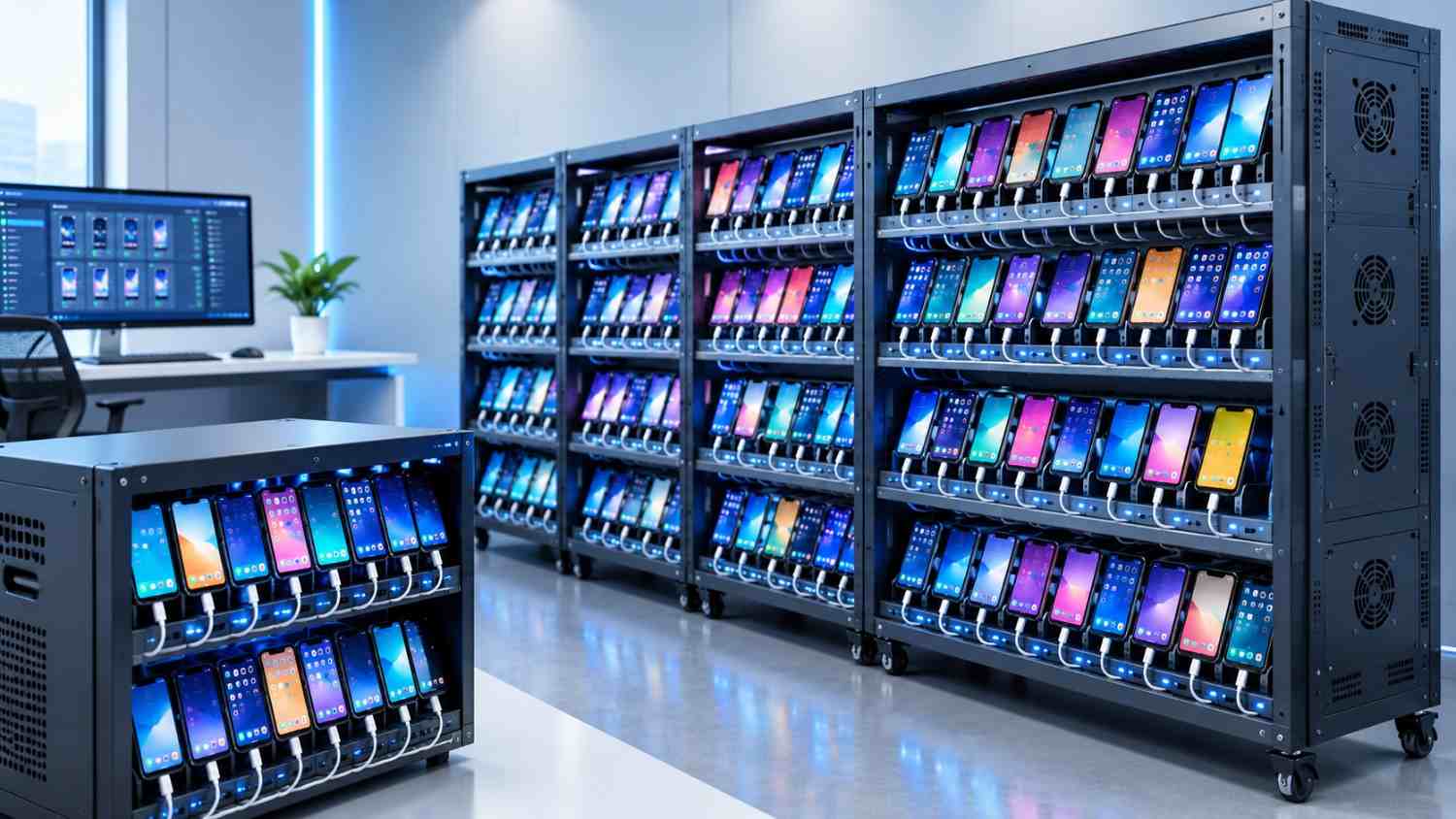
A Phone Farm is a rack filled with real phones-or sometimes just their motherboards-all connected to one computer. This lets one person control many phones at the same time.
Companies use phone farms to test apps on real devices and run the same tasks across many phones without handling each one manually. The idea is simple, but the setup can get quite interesting.
We build this equipment in Shenzhen at CXT Factory. So, in this guide, we’ll explain things from the manufacturing side: what’s inside a phone farm, how to set one up, what to check before buying one, and what can go wrong when a system grows faster than the plan behind it.
What Exactly Is a Phone Farm?
Picture a developer with forty test phones in a drawer. Every release, somebody digs them out, charges them, installs the build and taps through the same screens forty times. Nobody enjoys that job. Now wire those same devices to a shared power supply and network, add control software, and the whole drawer answers to one screen.
That's the basic arrangement. You can send one command to everything, give each device its own task, or grab a single unit and poke around inside it. The phones stay real, so touch input, heat, network behavior and chipset quirks are all genuine. When people ask why anyone would bother with a phone farm when emulators exist, this is usually the answer. Emulators are quick and convenient, but they won't reproduce a fault that only appears on one specific processor.
Setups come in three broad types. DIY shelves are the cheapest and the messiest. Box systems put phones or bare boards into an engineered chassis. Hosted services let you rent time on somebody else's devices. We build boxes.
Who Actually Uses One?
App developers, mostly. They need a new build checked on dozens of real handsets before it ships. QA teams come next, especially the ones chasing a bug that only happens on a single model. Then you get marketing and research people verifying how an ad or a landing page renders across devices, and game studios that want a title hammered for hours with nobody watching.
The appeal is mostly about time. A phone farm takes a test cycle that used to swallow an afternoon and lets it run overnight, so the results are already waiting when you sit down with coffee. One engineer, one screen, a lot of devices.
It also suits small teams. One engineer with a well-planned rack can cover ground that once took several people swapping cables and charging handsets.
What Hardware Goes Into a Setup?
Any phone farm, big or small, is built from the same five parts.
- Devices: whole phones, or bare motherboards taken out of them
- Power: steady supply sized for nonstop running rather than occasional charging
- Control: a host PC running group-control software
- Network: wired or wireless links, ideally with a proper router and switch
- Housing: a rack or chassis with decent airflow and cabling you can follow
Most people spend too much time choosing which phones to buy. That matters, but the real problems usually come from weak power, overheating boxes, and cables that nobody labeled.
How Does a Box Design Save Space and Power?
Most of a phone is dead weight in a test rack. The screen, battery, camera and SIM slot rarely matter when you're running scripted checks. Motherboard boxes take advantage of that. CXT Factory's Android Motherboard Box, for example, strips those parts out and fits 20 phone motherboards into one chassis measuring roughly 55 x 38 x 16 cm. It weighs about 7 kg, light enough to carry on your own.
This is where a phone farm Box earns its place over loose shelves. Density goes up, cable chaos goes down, and the power draw is easy to plan for because each unit uses around 100 watts when it's working hard.
On the control side, one PC handles three to five boxes. Do the math and that's 60 to 100 boards from one workstation. You can send commands to all of them, or open one and work on it alone. Connection runs over USB or through a router's network cable, and you can switch between the two.
Not every buyer wants bare boards, so box formats vary. Here's how three of them compare-
| Model | Capacity | Key features |
|---|---|---|
| Motherboard Box | 20 boards per box | About 55 x 38 x 16 cm, roughly 7 kg, around 100 W; one PC manages 3 to 5 boxes |
| 12PCS Phone Array | 12 drawers | Each drawer holds a full phone or a motherboard; hot-swappable; built-in PC; USB 2.0 hub |
| 32PCS Phone Box | 32 units | Unified control; ROM customization supported |
Android or iPhone: Which Route Fits You?
Android is the most common choice for this type of hardware because it can easily manage many devices at the same time. That’s why most group-control boxes, including the Motherboard Box, are designed for Android phones and boards.
iPhones work a little differently. Some dedicated iPhone boxes are available, including one from CXT Factory that can work without changing the phone’s software or installing an app. However, it’s still a good idea to check the manual for the exact model before buying. The best choice depends on the type of phones your users actually have, not just the phones used in your office.
What Should You Look for in a Supplier?
Price is easy to compare. Everything behind the price is harder. A dependable phone farm supplier can tell you how the equipment behaves after 24 hours of continuous load, not just show you a nice product photo.
A short checklist before you order:
- Is the seller a real manufacturer or a reseller?
- What are the exact specs: board count, dimensions, weight, wattage?
- Can you read a manual before you pay?
- Do they handle customization, like ROM changes or extra software features?
- How fast do they answer, and is the answer clear?
- Have they shipped to your region before?
These are simple questions. They help you tell the difference between sellers who understand their hardware and sellers who simply resell someone else’s products. Ask sellers questions to see if they really know their products. You’ll appreciate this when something goes wrong and you need help fixing it.
How Does the Software Side Work?
Once the boards are online, the control software running your phone farming machine lists every device in a single window. You can select all the devices, a group, or just one device. You can then do the same task on all of them at once, or give each device a different task.
Many teams put a simple script on the repetitive jobs, such as rerunning the same test whenever a new build comes out. Writing one doesn't take much programming skill. What matters more is having at least one person who can open an error log, work out why a run failed, and tweak a line or two in the script to fix it. That habit tends to pay off sooner than buying faster hardware.
What Should You Prepare Before Requesting a Quote?
A few details make the first conversation much quicker, and you'll get a more accurate answer.
Start with how many devices you plan to run, and whether you want to begin with one box or several. Say whether your test devices are Android or iPhone, since that decides which hardware fits. Mention where the equipment will be installed, so shipping and power can be planned around your region and voltage.
It also helps to tell us early if you need something custom, such as a ROM change or a software feature. And if you already have a test workflow in mind, describe it in a couple of lines. Send all of this by email or WhatsApp, and we'll reply with a quote that matches your setup.
How Do You Set One Up Without Headaches?
Start with one box. Get a phone farm running cleanly with your real workflow before you order anything else, because every setup teaches you something about your own tasks that a spec sheet never will. Here's the order that tends to work.
- First, the spot. Pick a room where air can move, with a sturdy table or shelf and a power point close by. Check the voltage too. The Motherboard Box, for one, runs on 220V, so make sure that matches what you have on the wall.
- Second, power and network. Plug in power first, then connect the router. Wired is the safer choice, and the box connects either by USB or through a router's network cable, so use whichever suits your layout.
- Third, the control PC. Install the group-control software and bring the boards online in batches instead of all at once. If a device won't connect, check the usual suspects before anything else: a weak USB port on the computer, a loose or damaged data cable, or a worn data connector on the phone itself. Swapping the cable fixes more problems than you'd expect.
- Fourth, keep Developer Options switched on, and buy a spare screen for a matching phone model if you can. One accidental tap on a permission prompt can block the connection, and a spare screen lets you clear it by hand.
- Last, label and test. Number every board, write down its address, and run one small script across the lot before you trust it with real work. Labels feel fussy right up until device 37 acts up and you need to find it in ten seconds.
Networking, Cooling and Power: The Basics That Matter
Start with the network. If you have many devices, a wired connection is usually more reliable than Wi-Fi. A good router and network switch can help keep all the devices connected. Give each device its own fixed IP address and keep a simple list of them. This will make it easier to find and manage each device when you need to.
Heat can build up quickly. A phone farm running all day produces a lot of heat, and without good airflow, the devices may slow down or restart. Leave some space around each box, keep the room cool, and don’t place the boxes directly against a wall.
Then power. At about 100 watts per box, five boxes want roughly 500 watts. Modest, but it never stops. Use good sockets, skip the daisy-chained strips, add surge protection, and if the mains in your area are unreliable, a UPS is cheap insurance.
How Do You Scale From 20 Phones to 100?
One box gives you 20 devices. Five boxes on one PC gets you to 100, and that's the practical ceiling for a single workstation. Beyond it you add another PC instead of piling more boxes onto the first.
Grow in steps, and never more than double at a time. A phone farm that runs nicely at 40 devices can still stumble at 80 if the network or power wasn't sized ahead of time, and fixing that is much cheaper before the racks fill up.
Also plan for basic maintenance: keep spare boards, have a replacement plan, and check the fans and cables every month.
What Does It Really Cost to Own One?
The purchase price is only part of it. Once a Phone Farm is running, you also pay for electricity, a network switch, spare boards, some cooling, and the time someone spends keeping it all healthy. Compare the total over a full year instead of the price of one unit. A box that costs a little more but never needs a midnight restart usually turns out cheaper.
Configuration changes the numbers a lot, which is why serious sellers quote per order rather than publishing one price. Work out your device count, your platforms and your installation space first, and the quotes you collect will be far easier to compare.
Buying Mistakes We See Again and Again
Ordering big before testing small. Comparing on price alone. Forgetting shipping time and import duties on an overseas order. Remembering the network switch only after the boxes have arrived. None of it is fatal, and all of it can be avoided.
Another classic is treating every online phone farm shop as interchangeable. Read the specs, ask for the manual, and message the seller with a real question. How quickly and how clearly they reply tells you plenty about how they'll behave once your payment has gone through.
One smaller slip that hurts later: skipping the paperwork. Keep a simple record of each unit's serial number, purchase date and place in the rack. When something needs replacing or a warranty question turns up, you'll be glad that spreadsheet exists.
Where Are the Limits on Using One Responsibly?
This equipment is meant for development, testing, research and quality assurance. It gets a bad reputation because some people use similar setups for fake views, spam or ad fraud, and those uses break platform rules and often the law.
Before you buy, read the terms of every app you plan to test against, and keep your use clearly on the legitimate side. It protects your accounts, your business and the reputation of everyone else doing honest testing.
So, Is It Worth Building One?
It depends on how often you test. If real-device testing is part of your weekly routine, a phone farm earns its place fast. You stop swapping cables and hunting for the one handset that reproduces a bug, and problems get caught before a customer sees them. Everything also runs from a single spot, which makes life easier for the whole team.
If you only run device tests a couple of times a year, the upfront cost is hard to justify. Renting hosted devices for those occasional runs is the cheaper route.
Frequently Asked Questions
How many phones can one PC control?
With Motherboard Boxes of 20 boards each, one PC can manage three to five boxes, so 60 to 100 devices.
Is it legal to run one?
Owning the hardware isn't illegal by itself. Legality depends on what it's used for, and fraud or breaking platform rules can cause real trouble. This isn't legal advice.
Do I need coding skills?
Not for basic group control. Scripting helps once you want to automate repeat test flows.
Need help choosing hardware? Contact CXT Factory: fiona@cxtfactory.com | WhatsApp +86 13410520058 | www.cxtfactory.com
```